player.gg

Search games

Publisher: Dempa Shimbunsha
Sort games
10 games
Xevious

Xevious

Namco, U.S. Gold, Enix Corporation, Atari Corporation, Namco Bandai Games, Atari, Mindscape, Dempa Shimbunsha

It's a nightmare, but it's true! Research shows that we are the actual aliens on Earth, and the ruthless Xevions are the original inhabitants. Now the Xevions want Earth back -- minus humans! Their invasion forces are fierce -- the land is crawling with deadly Domogram Rovers; the sky is black with Toroid Patrol Fleets and Zoshi Death Squads. Our puny weapons offer no defense. Earth's only hope is our powerful new Solvalou Fighter Plane. Its pilot will have a single mission: Penetrate the enemy ranks and destroy the Xevious Mother Ship. The mission is dangerous. We can't guarantee success. But at this point, it's do or die! One small problem. We still need a pilot. Any volunteers?

ArcadeShooter
New Rally-X

New Rally-X

Namco, Namco Limited, NAMCO BANDAI Games Inc., MediaKite Distribution, Dempa Shimbunsha

New Rally-X is a maze and driving arcade game that was released by Namco in 1981. It runs on similar hardware to that of its predecessor, and as its name suggests, it is a revised version of that title, which was released in the previous year. The only differences are that it has slightly enhanced graphics, easier gameplay, a new soundtrack, and a "Lucky Flag" (with the letter "L") that gives the player extra points for remaining fuel when collected, after which the round will continue if there are still flags remaining. The mazes are mostly identical, with some of the blocks from Rally-X changed into roads to reduce dead ends, and some different flag (and rock) locations. This title was manufactured in greater numbers and was much more popular in Japan than its predecessor.

Racing
Bosconian

Bosconian

Namco, Micomsoft, Dempa Shimbunsha, Midway Games

The object of Bosconian is to score as many points as possible by destroying enemy bases and ships. The player controls a small fighter ship that can move in eight directions and can fire both forward and backward. Each level consists of a number of green space stations that must all be destroyed to advance to the next level (a semi-transparent mini-map helps identify their location). Each station consists of six cannons arranged in a hexagon, surrounding a central core. The player must either destroy all six cannons or shoot the core to destroy a station, and in later levels the core is capable of defending itself. Additionally, the player must avoid or destroy asteroids, mines, and a variety of enemy missiles and ships that attempt to collide with the player's ship. Enemies occasionally launch formation attacks — destroying the leader causes all remaining enemies to disperse, but destroying all enemies in a formation scores extra bonus points. A spy ship (worth a random bonus value) also appears occasionally, which must be destroyed or the enemies will go berserk.

ArcadeShooter
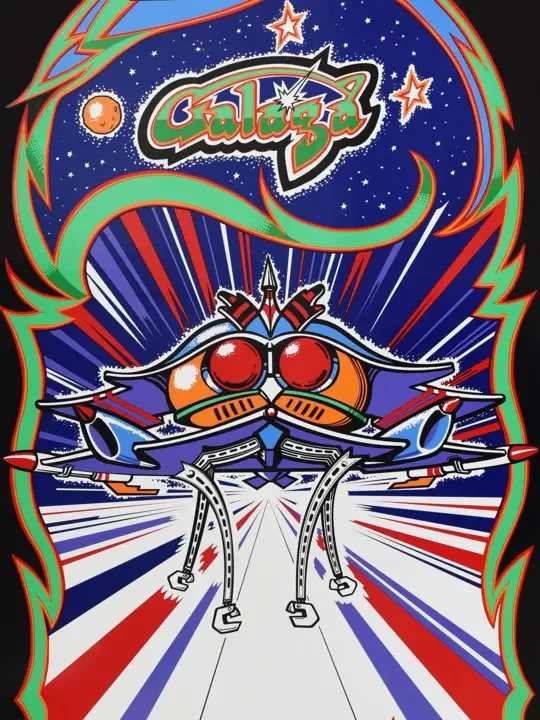
Galaga

Galaga

Namco Limited, Midway, NAMCO BANDAI Games Inc., Dempa Shimbunsha, Bug-Byte Software, MediaKite Distribution

The objective of Galaga is to score as many points as possible by destroying insect-like enemies. The player controls a starfighter that can move left and right along the bottom of the playfield. Enemies swarm in groups in a formation near the top of the screen, and then begin flying down toward the player, firing bombs at the fighter. The game ends when the player's last fighter is lost, either by colliding with an enemy or one of its bullets, or by being captured. Galaga introduces a number of new features over its predecessor, Galaxian. Among these is the ability to fire more than one bullet at a time, a count of the player's "hit/miss ratio" at the end of the game, and a bonus "Challenging Stage" that occurs every few levels, in which a series of enemies fly onto and out of the screen in set patterns without firing at the player's ship or trying to crash into it. These stages award a large point bonus if the player manages to destroy every enemy. Another gameplay feature new to Galaga is the ability for enemies to capture the player's fighter. While the player is in control of just one fighter, a "boss Galaga" (which takes two shots to kill) periodically attempts to capture the fighter using a tractor beam. If successful, the fighter joins the enemy formation. If the player has more lives remaining, play resumes with a new fighter. The captured fighter flies down with the enemy that captured it, firing upon the player just like normal enemies, and can be shot and destroyed. The player can free the fighter by destroying the boss Galaga while in flight, causing the captured fighter to link up with the player's current fighter, doubling his or her firepower but also making a target twice as large. Galaga has an exploitable bug that can cause the attackers to stop firing bullets at the player, due to a coding error. In addition, similar to the famous "Split-Screen bug" in Pac-Man, a bug exists in Galaga in which the game "rolls over" from Level 255 to Level 0. Depending on the difficulty setting of the machine, this can cause the game to stall, requiring that the machine be reset or power-cycled in order to start a new game.

ArcadeShooter

Battle City

Battle City

Namco, Bandai Namco Games, Dempa Shimbunsha, Namco Bandai Games, Bandai Namco Entertainment

Battle City, also known as Tank 1990 or Tank in some pirate multicart releases, is a multi-directional shooter video game for the Family Computer produced and published in 1985 by Namco. The game was later released for the Game Boy and was included in the Japanese version of Star Fox: Assault. It is a port of the arcade game Tank Battalion with additional features (including two player simultaneous play and a level edit feature). There was also a rendition for Nintendo's Vs. System arcade cabinets. The player, controlling a tank, must destroy enemy tanks in each level, which enter the playfield from the top of the screen. The enemy tanks attempt to destroy the player's base (represented on the map as a bird, eagle or Phoenix), as well as the human tank itself. A level is completed when the player destroys all 20 enemy tanks, but the game ends if the player's base is destroyed or the player loses all available lives.

FightingPuzzleShooter
Bump 'n' Jump

Bump 'n' Jump

Data East, Coleco, Mattel Electronics, G1M2, Telegames, Technology Associates, Dempa Shimbunsha

Bump 'n' Jump is an overhead-view vehicular combat game developed by Data East and originally released in Japan as "Burnin' Rubber". The arcade version was available as both a dedicated board and as part of Data East's DECO Cassette System. It was distributed in North America by Bally Midway. The goal is to drive to the end of a level while bumping enemy vehicles into the sides of the track and jumping over large obstacles such as bodies of water. The arcade game was a commercial success in Japan and North America. The game was ported to the Atari 2600, Intellivision, ColecoVision, Nintendo Entertainment System, and Sharp X1. The Famicom version of Burnin' Rubber was published as "Buggy Popper" in Japan in 1986.

ArcadeRacing