player.gg

Search games

Developer: Namco Limited
Sort games
29 games
1 / 2
New Rally-X

New Rally-X

Namco, Namco Limited, NAMCO BANDAI Games Inc., MediaKite Distribution, Dempa Shimbunsha

New Rally-X is a maze and driving arcade game that was released by Namco in 1981. It runs on similar hardware to that of its predecessor, and as its name suggests, it is a revised version of that title, which was released in the previous year. The only differences are that it has slightly enhanced graphics, easier gameplay, a new soundtrack, and a "Lucky Flag" (with the letter "L") that gives the player extra points for remaining fuel when collected, after which the round will continue if there are still flags remaining. The mazes are mostly identical, with some of the blocks from Rally-X changed into roads to reduce dead ends, and some different flag (and rock) locations. This title was manufactured in greater numbers and was much more popular in Japan than its predecessor.

Racing
Gaplus

Gaplus

Namco Limited, Namco, Carry Lab, Mastertronic

Gaplus is a fixed shooter arcade game that was released by Namco in 1984. It was the only other game to run on Namco Phozon hardware, and in the US, a modification kit was later released to change the name to Galaga 3, possibly to increase recognition among fans of the games even though there was no "Galaga 2". Since Gaplus is a sequel to Galaga, it has similar gameplay. The player controls a spaceship, that can now move vertically (limited to halfway up the screen, much like Atari's Centipede) as well as horizontally, and shoots at swarms of incoming insect-like aliens which fly in formation above it and swoop down to attack it in akamikaze-like dive. In this sequel, the level starts over if the player gets killed before all the enemies have come in. When all enemies are killed, the player moves on to the next level. By obtaining certain powerups, it is possible to shoot sixty bullets per screen, the most any Galaxian-related game has.

ArcadeShooter
Dig Dug

Dig Dug

Namco Limited, Atari

Dig Dug is a 1-2 player arcade game in which you have to use your shovel to dig your way through the earth. Stopping you from doing this are two monsters, called Pooka and Fygar, who will continually chase you around. The only weapon that you carry is an air pump, which you can use to inflate the monsters to the point where they explode. (if you start to inflate them but stop doing so, the monsters will get turned back to their normal selves). Furthermore, rocks are scattered throughout the earth, and you can use these rocks to squash them. If the monsters do not find you for several seconds, they will eventually get turned into ghosts, which can walk through the earth. They are invincible and cannot be killed. From time to time, vegetables will appear in the center, and you can get these for points.

Arcade
Galaga

Galaga

Namco Limited, Midway, NAMCO BANDAI Games Inc., Dempa Shimbunsha, Bug-Byte Software, MediaKite Distribution

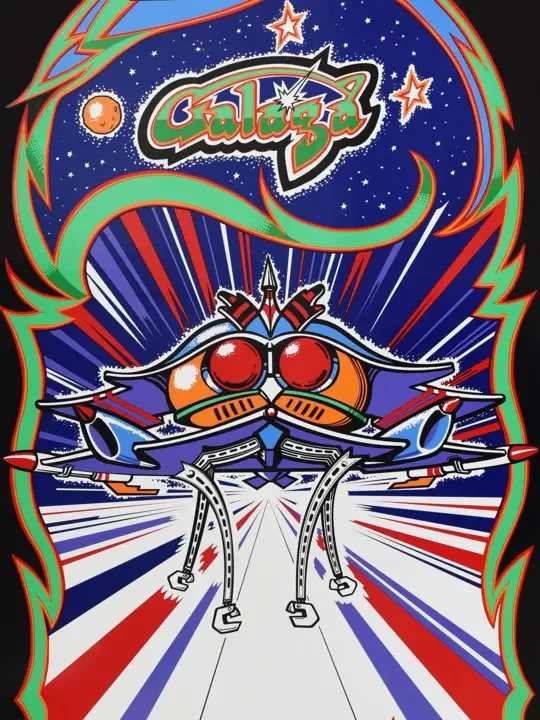
The objective of Galaga is to score as many points as possible by destroying insect-like enemies. The player controls a starfighter that can move left and right along the bottom of the playfield. Enemies swarm in groups in a formation near the top of the screen, and then begin flying down toward the player, firing bombs at the fighter. The game ends when the player's last fighter is lost, either by colliding with an enemy or one of its bullets, or by being captured. Galaga introduces a number of new features over its predecessor, Galaxian. Among these is the ability to fire more than one bullet at a time, a count of the player's "hit/miss ratio" at the end of the game, and a bonus "Challenging Stage" that occurs every few levels, in which a series of enemies fly onto and out of the screen in set patterns without firing at the player's ship or trying to crash into it. These stages award a large point bonus if the player manages to destroy every enemy. Another gameplay feature new to Galaga is the ability for enemies to capture the player's fighter. While the player is in control of just one fighter, a "boss Galaga" (which takes two shots to kill) periodically attempts to capture the fighter using a tractor beam. If successful, the fighter joins the enemy formation. If the player has more lives remaining, play resumes with a new fighter. The captured fighter flies down with the enemy that captured it, firing upon the player just like normal enemies, and can be shot and destroyed. The player can free the fighter by destroying the boss Galaga while in flight, causing the captured fighter to link up with the player's current fighter, doubling his or her firepower but also making a target twice as large. Galaga has an exploitable bug that can cause the attackers to stop firing bullets at the player, due to a coding error. In addition, similar to the famous "Split-Screen bug" in Pac-Man, a bug exists in Galaga in which the game "rolls over" from Level 255 to Level 0. Depending on the difficulty setting of the machine, this can cause the game to stall, requiring that the machine be reset or power-cycled in order to start a new game.

ArcadeShooter

Metro-Cross

Metro-Cross

Namco Limited, U.S. Gold, Bandai Namco Entertainment

Metro-Cross is a platform arcade game that was released by Namco in 1985. It runs upon Namco Pac-Land hardware (but with a video system like that used in Dragon Buster, modified to support a 2048-color palette). It uses a Motorola M6809 microprocessor, with a Hitachi HD63701 sub-microprocessor (both running at 1.536 MHz) and Namco 8-channel waveform PSG for audio. The player must take control of a man known only as Runner, who is given a time limit to run through each of the game's thirty-two rounds while avoiding obstacles and collecting drink cans. The actual running happens automatically: the job of the player is to avoid the obstacles and collect the cans by moving the Runner with the stick and adjusting his speed accordingly. If the Runner finishes the round within the time limit, the remaining time will be awarded to him as bonus points and he will proceed to the next round. Every fourth round is special, using the remaining time from the three previous ones as additional time. However, if the Runner has not finished the round by the time the time limit runs out, he will be electrocuted and the game will immediately be over.

ArcadeRacingSport
StarBlade

StarBlade

Namco Limited, Panasonic, Namco Hometek, Bandai Namco Entertainment

Sitting in the gunner position of a "GeoSword" fightercraft, you must shoot your way through the enemy armada and bring the fight to their base planet, Redeye. Altogether you'll have around 10 missions to get through before the galaxy is safe and your wingmen will help you along the way. And during those missions, you'll be expected to shoot out the sides of huge enemy battlecruisers, travel inside of enemy carriers and travel through the canyons of Redeye to deliver your payload. The PlayStation and the 3DO versions offer the choice between an arcade mode and an enhanced mode. In the enhanced modes that flat polygons are remade in fully textured polygons and the black bars on the sides have been removed to turn the image into a fullscreen view.

Shooter
Final Lap

Final Lap

Namcot, Namco Limited

Final Lap is a racing video game produced by Namco,[2] and released by Atari Games for the United States in 1987. It was the first game to run on Namco's then new System 2 hardware, and is a direct successor to Namco's two earlier Pole Position games (1982-1983). Final Lap was the first racing game to allow up to eight players to simultaneously race on the Suzuka Circuit, in a Formula One race. This was, at the time, considered a revolutionary feature and was implemented by linking together up to four two-player sitdown-style arcade cabinets.[2][3] It was also arguably the first racing game to implement "rubber banding" to ensure that less talented players were never too far behind the leader, a concept that would be taken much further by the Mario Kart series.[3] There was also a single player mode, in which the player's score was based on how far the car travelled until time ran out or if the player completed four laps (on default settings; the arcade operator can set the lap number to be as low as three or as high as six).

ArcadeRacingReal Time Strategy (RTS)Role-playing (RPG)Strategy
1 / 2